Support our educational content for free when you purchase through links on our site. Learn more
Dark Chocolate and Weight Loss: Evidence, Portions, and Labels
Dark chocolate does not have a proven weight-loss dose. Learn what trials show and how to use serving size, calories, added sugar, and your overall eating plan to choose a portion.

Quick answer: there is no evidence-based daily dose of dark
chocolate that causes weight loss. Dark chocolate can fit into some weight-loss
plans, but it still contributes calories, saturated fat, and—depending on the
bar—added sugar. The useful question is not “How much chocolate burns fat?” It
is “What portion fits my overall eating plan without displacing foods I need or
moving me away from my goals?”
A meta-analysis of 35 randomized trials found no significant overall effect
of cocoa or dark-chocolate supplementation on body weight, body mass index, or
waist circumference. A newer meta-analysis likewise found no reduction in body
mass, BMI, or waist circumference. Those findings do not mean chocolate must be
forbidden. They mean it should be treated as food—not as a weight-loss
treatment.
Key takeaways
- Dark chocolate has not been shown to produce meaningful weight loss on its own.
- No research establishes one universal number of grams, ounces, or squares for weight loss.
- Use the package serving size as information, not as a prescription.
- Compare calories, added sugar, saturated fat, ingredients, and how the portion fits your whole day.
- A small amount of a favorite higher-calorie food can fit some sustainable eating plans.
- Avoid claims that a particular cocoa percentage, brand, or time of day “burns fat.”
Table of contents
- What the research shows
- Why there is no universal dose
- A label-first portion method
- How to compare two bars
- Practical ways to make room for chocolate
- Claims to treat cautiously
- Frequently asked questions
- References
What the research shows about dark chocolate and weight
Cocoa contains flavanols and other compounds that researchers study for
cardiometabolic effects. That does not establish that an ordinary chocolate bar
causes fat loss. Products used in trials differ in cocoa form, flavanol content,
added sugar, energy, dose, and duration. Results from a cocoa powder, a
standardized extract, and a retail candy bar are not automatically
interchangeable.
The most direct evidence is unglamorous but useful. A
systematic review and
meta-analysis of 35 randomized trials found no significant overall change
in weight, BMI, or waist circumference. A
2024 randomized-trial
meta-analysis also found no effect on body mass, BMI, or waist circumference.
Subgroup findings should not be turned into a universal chocolate prescription,
especially when the overall result is neutral.
The National Institute of Diabetes and Digestive and Kidney Diseases
describes weight management as a sustainable eating-pattern and activity
question. Its guidance focuses on an eating plan that can be maintained over
time, while noting that a small amount of a favorite higher-calorie food may fit
when accounted for. That is a more defensible framework than adding chocolate
in the hope that it will increase metabolism or melt fat.
Why there is no universal dark-chocolate dose for weight loss
A square is not a standard unit. One brand’s square can be much larger than
another’s, and bars with the same cocoa percentage can have different calories,
added sugar, saturated fat, fillings, and serving sizes. Personal energy needs
also differ. A serving printed on a package is a reference amount for that
product; it is not proof that the amount is appropriate for every person or
goal.
Harvard’s Nutrition Source notes that dark chocolate is energy-dense and can
contribute to weight gain when eaten in excess. It also explains that the
long-term implications for weight control are unclear. This is why promises
such as “eat one ounce daily,” “have chocolate before every meal,” or “choose
85% cocoa to make weight fall faster” go beyond the evidence.
A label-first method for choosing a portion
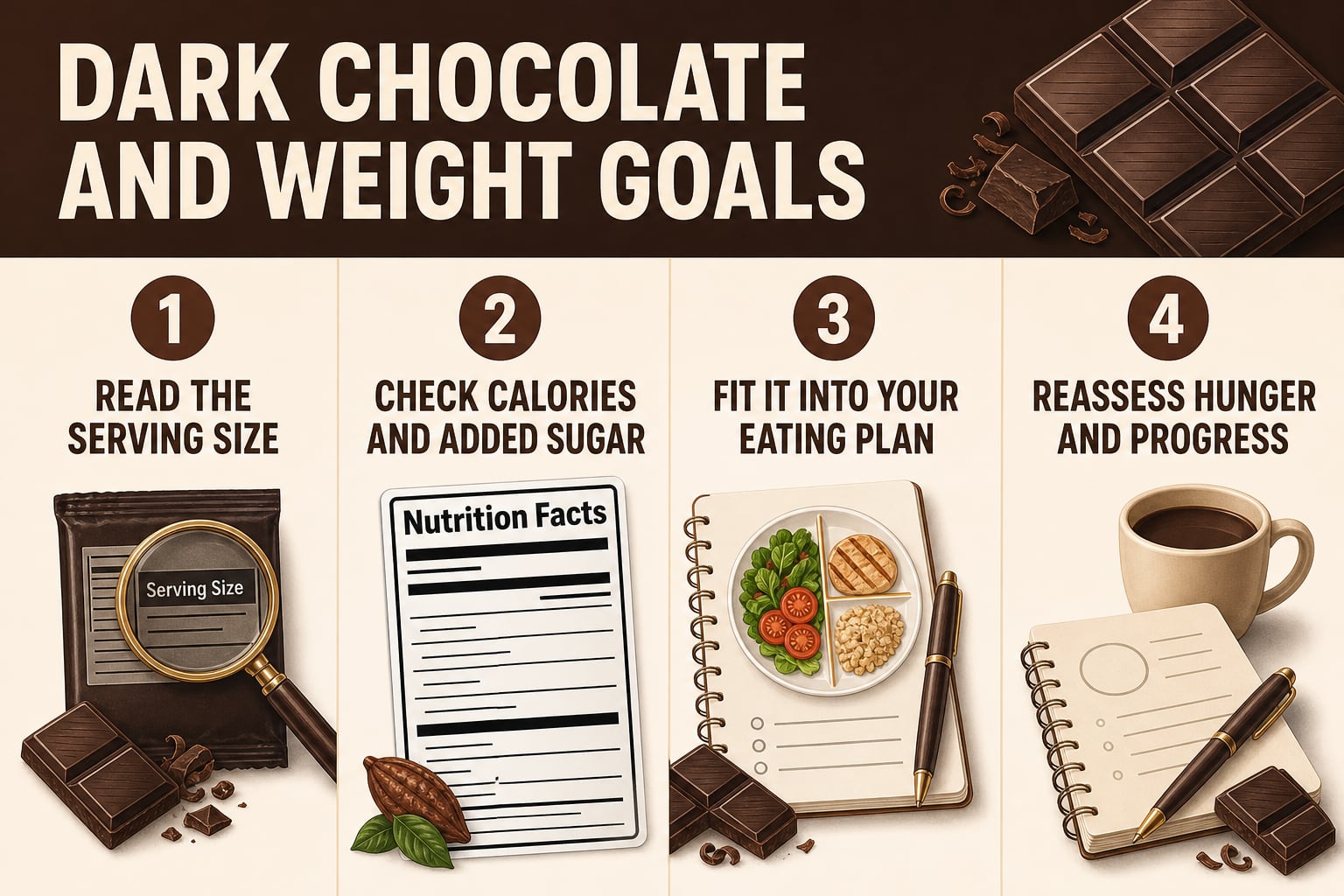
- Read the serving size. Notice whether the label defines a serving as pieces, a fraction of the bar, or the whole package.
- Check calories and added sugar. Consider what the portion contributes alongside everything else you plan to eat.
- Check saturated fat and ingredients. Cocoa percentage alone does not describe the full nutrition profile.
- Choose a portion you can repeat realistically. A plan that routinely leaves you feeling deprived or triggers unplanned eating may need adjustment.
- Review the result over time. Track the eating pattern and relevant outcomes rather than crediting or blaming one food after one day.
The FDA’s Nutrition Facts guidance provides two useful comparison shortcuts:
5% Daily Value or less is considered low for a nutrient, while 20% or more is
high. The Daily Value for added sugar is a population-level label reference,
not a personalized target. Use it to compare products and understand how one
serving contributes to the day.
How to compare two dark-chocolate bars
Compare the same amount or the same number of calories rather than comparing
one brand’s tiny serving with another brand’s larger serving. This table keeps
the decision tied to information actually printed on the package.
| Label item | What to compare | Why it matters |
|---|---|---|
| Serving size | Grams and pieces per labeled serving | “One square” is not consistent across brands |
| Calories | Calories for the portion you actually expect to eat | Dark chocolate is energy-dense |
| Added sugar | Grams and percent Daily Value | Products with similar cocoa percentages can differ |
| Saturated fat | Grams and percent Daily Value | The overall nutrition profile matters, not only cacao |
| Ingredients | Fillings, sweeteners, allergens, and serving additions | Added ingredients can change energy and suitability |
| Cost and enjoyment | Whether a smaller planned amount is satisfying and affordable | A sustainable choice must work outside a spreadsheet |
Cocoa percentage can still be useful for flavor and product style. It should
not be treated as a score for weight-loss effectiveness. If heavy-metal
reporting is part of your buying decision, see our explanation of
what
product testing can and cannot establish.
Practical ways to make room for chocolate
Start with your existing pattern
Do not add a “required” chocolate dose on top of your usual intake. First
look at where sweets already appear in your week. If dark chocolate is the treat
you enjoy most, you may choose it instead of another dessert rather than adding
both.
Portion before eating
Separate the amount you intend to eat, put the package away, and enjoy the
portion without multitasking when practical. This is a planning technique, not
a metabolic trick. Its purpose is to make the decision visible.
Use the actual label
Recipes and generic databases may not match the exact bar in your hand.
Fillings, nuts, wafers, caramel, sugar alcohols, and package size can materially
change the numbers. The current package label is the better starting point.
Evaluate the whole plan
Weight trends reflect a much larger pattern than one snack. The CDC and
NIDDK include food choices, physical activity, sleep, stress, medicines, and
health conditions in their weight-management guidance. If your plan is not
working or eating feels difficult to control, individualized support is more
useful than changing cocoa percentage.
Dark-chocolate weight-loss claims to treat cautiously
- “A specific number of grams guarantees weight loss.” No universal dose has been established.
- “Dark chocolate specifically reduces abdominal fat.” This turns limited mechanistic research into a body-composition promise.
- “Eating it before or after a meal prevents cravings.” Individual experiences are not a dosing guideline.
- “Higher cacao always means better for weight loss.” The complete label and actual portion still matter.
- “One brand is clinically best.” Brand rankings require current, comparable product evidence and should not be inferred from general cocoa research.
- “A health halo cancels the calories.” A food can contain interesting compounds and still contribute meaningful energy.
Frequently asked questions
Can dark chocolate be part of a weight-loss plan?
Yes, for many people it can fit as a planned food. The evidence does not show
that it causes weight loss by itself. Its calories and other label values still
count within the overall eating pattern.
How many squares should I eat?
There is no standard square size and no universal weight-loss dose. Check the
bar’s serving size and nutrition information, then choose an amount that fits
your individualized plan.
Is 70%, 85%, or 100% cacao best for weight loss?
No cacao percentage has been proven best for weight loss. Higher-percentage
bars often taste less sweet, but formulas vary. Compare the complete label,
ingredients, portion, price, and your preference.
Should I eat dark chocolate at a particular time?
No time of day has been established as a fat-loss window. Timing can be a
personal planning choice. If chocolate’s caffeine or theobromine affects your
sleep or symptoms, discuss an appropriate approach with a health professional.
What if I have diabetes, high blood pressure, allergies, or take medication?
Use advice tailored to your condition and medicines. Do not replace
prescribed treatment with chocolate or cocoa products.
References
- Systematic review and meta-analysis of cocoa/dark chocolate and body weight, BMI, and waist circumference
- Meta-analysis of randomized trials on cocoa and cardiometabolic risk markers
- NIDDK: Eating and physical activity to lose or maintain weight
- NIDDK Body Weight Planner
- CDC: Steps for losing weight
- FDA: Added sugars on the Nutrition Facts label
- Harvard Nutrition Source: Dark chocolate
Reviewed July 29, 2026. Product labels and evidence can change; verify
the current package and source before acting on a numerical claim.