
Support our educational content for free when you purchase through links on our site. Learn more
How Much Chocolate Should You Eat in a Week?

There is no evidence-based weekly chocolate allowance that fits every person. A practical plan starts with the product’s serving information, the number of occasions you want to include it, and how its added sugar, saturated fat, and calories fit into the rest of your dietary pattern. The serving size on a label is a reference based on what people typically consume; the FDA explicitly notes that it is not a recommendation for how much you should eat.
This guide gives you a repeatable weekly planning method without turning chocolate into a supplement, treatment, or mandatory daily habit. If a clinician has given you individualized guidance for diabetes, an allergy, kidney disease, cardiovascular disease, pregnancy, or another condition, that advice takes priority.
The quick answer
Plan chocolate as an optional treat within the whole week rather than searching for a universal dose. Decide which occasions matter to you, read the label for the exact product, account for the number of servings you will actually eat, and compare products on added sugar and saturated fat. More cocoa is not an automatic permission slip: recipes, serving sizes, and nutrient profiles vary.
How our team plans a tasting week
Our Chocolate Brands team has tasted everything from traditional cacao drinks to modern artisanal bars. We have seen firsthand how bean quality, roast, formulation, temper, storage, and serving temperature can change flavor and texture even when two labels show a similar cacao percentage.
When several bars are open for review, we do not treat the package serving as a health target. We decide which tasting occasions matter, portion only what is needed for comparison, record the product and sensory notes, and account for the rest of the week. That operating method preserves enjoyment and comparability without pretending that our experience creates a universal allowance.
Relevant portion and tasting resources
Affiliate disclosure: Some relevant resources below use Amazon Associate links. If you buy through them, Chocolate Brands may earn a commission at no extra cost to you. Inclusion is based on relevance to the reader’s task, not on whether a commission is available.
A four-step weekly method
- Pick occasions before portions. Mark the meals, celebrations, or snacks where chocolate would add the most enjoyment. This prevents an abstract weekly target from becoming a requirement to eat chocolate when you do not want it.
- Read the serving line. Note the household measure, gram amount, and servings per package on the Nutrition Facts label. If you eat two labeled servings, the listed calories and nutrients generally need to be counted twice.
- Compare the nutrients that can accumulate. Look at added sugar and saturated fat in the context of everything else you eat that day and week. The American Heart Association recommends minimizing added sugars and replacing sources of saturated fat with unsaturated fats as part of an overall heart-healthy pattern.
- Review the pattern, not one ingredient. A chocolate bar does not cancel a nutrient-dense diet, and a high cocoa percentage does not repair a dietary pattern that lacks vegetables, fruit, whole grains, and useful protein sources.
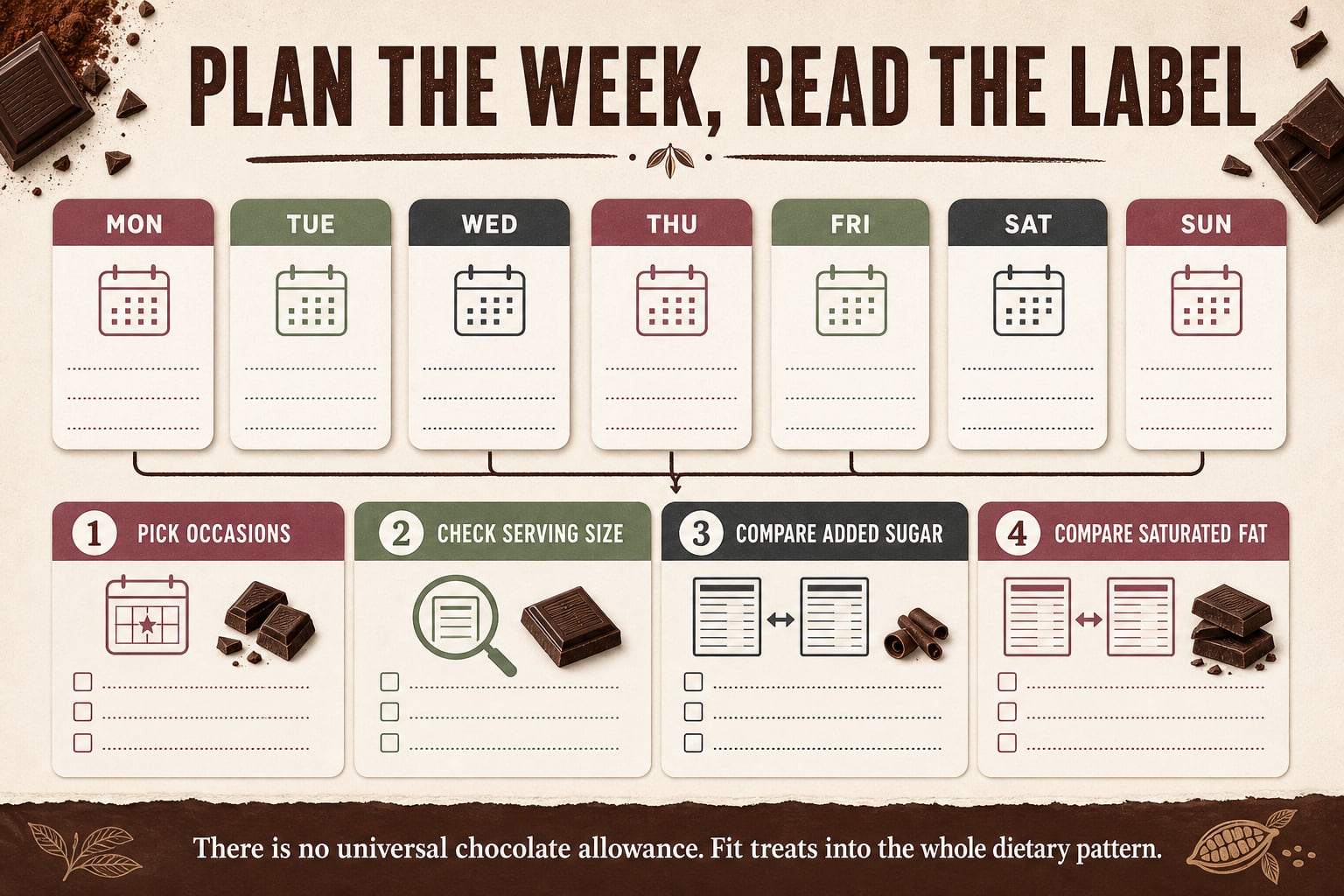
What to compare on chocolate labels
| Label field | Why it matters | Common mistake |
|---|---|---|
| Serving size | Defines the amount used for the listed nutrition values | Treating it as a personal prescription |
| Servings per container | Shows whether a package contains more than one labeled serving | Reading package totals as if they were serving totals |
| Added sugars | Allows comparison across products with different recipes | Assuming “dark” always means little added sugar |
| Saturated fat | Places cocoa butter, dairy, and other fats in the day’s pattern | Ignoring it because cocoa contains flavanols |
| Ingredients and allergens | Identifies milk, nuts, soy, sweeteners, and recipe differences | Relying only on the front-of-package name |
The FDA explains that Nutrition Facts values are usually listed per serving, while some packages also provide information for the whole container. Use the format that matches what you actually eat. “Percent cacao” describes cocoa-derived ingredients; it does not, by itself, disclose added sugar, saturated fat, allergens, flavanol content, or contaminant testing.
Frequency and total amount answer different questions
“How many days?” and “how much altogether?” are not interchangeable. A small amount on several occasions and a large amount on one occasion can create different habits while still producing a similar weekly total. Neither pattern is automatically best.
A useful weekly review asks:
- Did the planned occasions match what you actually enjoyed?
- Did the package contain more servings than you assumed?
- How did the product’s added sugar and saturated fat fit with the rest of those days?
- Did chocolate replace a meal, fruit, nuts, or another food you intended to eat?
- Are you following an online “dose” for a health result the product has not been shown to deliver?
This method is deliberately different from our dark chocolate and weight-goal evidence guide, which explains why chocolate is not a weight-loss dose, and our chocolate and longevity fact check, which separates observational associations from causal evidence.
When generic guidance is not enough
Chocolate products can differ in allergens, caffeine and theobromine content, added sugar, saturated fat, and ingredients. Cocoa solids can also contain cadmium, with levels influenced by growing region and cocoa-solids percentage. The FDA says chocolate is a minor source of dietary cadmium internationally and cautions that detecting a contaminant does not by itself make a food unsafe. That context does not make one unverified brand “metal-free” or suitable for everyone.
Ask a qualified clinician or registered dietitian for individualized advice when you are managing a diagnosed condition, medication interaction, allergy, pregnancy-related concern, or medically prescribed diet. Do not replace treatment or a prescribed eating plan with a chocolate routine.
Frequently asked questions
Should everyone eat chocolate every week?
No. Chocolate is optional. There is no nutritional requirement to include it, and the best frequency depends on preferences, the product, the rest of the diet, and any individualized medical guidance.
Is a serving size the amount I should eat?
No. The FDA says serving sizes reflect amounts people typically consume; they are not recommendations. They provide a consistent basis for reading the label.
Does a higher cacao percentage make a product healthy?
Not automatically. It does not replace checking serving size, added sugar, saturated fat, ingredients, allergens, and the overall dietary pattern.
Can I save the whole week’s chocolate for one day?
A universal answer is not supported. Use the actual label totals and consider whether the pattern works for your preferences and health context rather than treating a weekly “budget” as a medical allowance.
Does this article recommend a chocolate dose?
No. It provides a planning and label-comparison method. It does not prescribe grams, ounces, squares, days per week, cacao percentage, or a brand.
References
- U.S. Food and Drug Administration: Serving Size on the Nutrition Facts Label
- American Heart Association: Diet and Lifestyle Recommendations
- American Heart Association: Added Sugars
- American Heart Association: Saturated Fats
- U.S. Food and Drug Administration: Cadmium in Food and Foodwares
Reviewed July 2026. This article provides general educational information, not individualized medical advice.