Support our educational content for free when you purchase through links on our site. Learn more
Dark Chocolate and Blood Pressure: What Research Shows

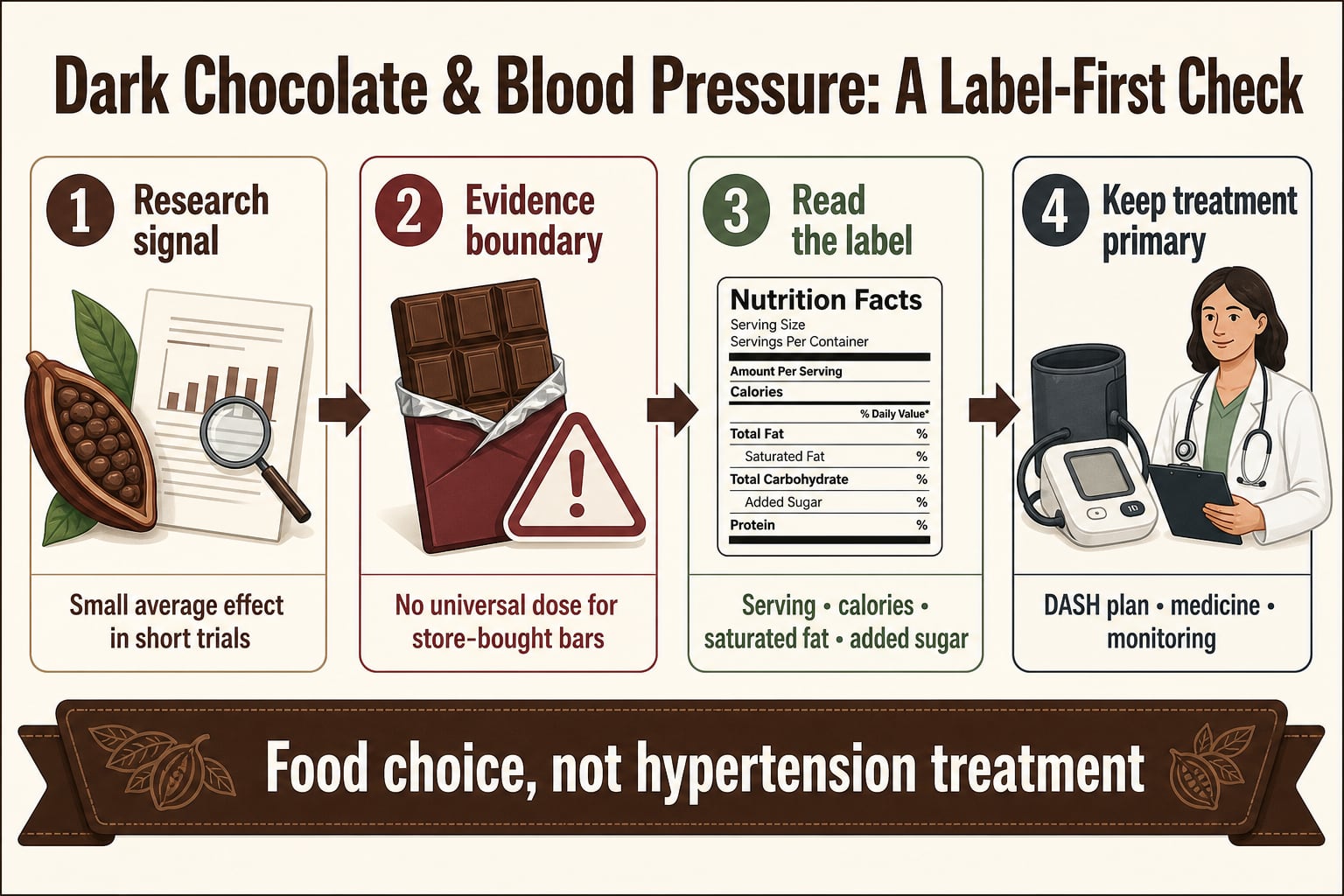
Quick answer: Research on flavanol-rich cocoa products suggests a small average reduction in blood pressure in some short-term trials, but it does not establish a universal daily amount of retail dark chocolate that treats hypertension. Products vary in flavanol content, calories, added sugar, and saturated fat. If you have high blood pressure, use chocolate as an optional food—not as a replacement for your treatment plan, prescribed medicine, or a DASH-style eating pattern.
Evidence boundary: This article translates research on cocoa and dark chocolate without prescribing a dose. Trial products are not interchangeable with every chocolate bar sold in stores, and an average study result cannot predict an individual response.
Key takeaways
- There is no evidence-based number of squares, grams, or ounces that reliably lowers an individual shopper’s blood pressure.
- Meta-analyses report small average effects, but studies differ in product, flavanol dose, duration, baseline blood pressure, and control treatment.
- A higher cacao percentage does not tell you the flavanol dose; processing can change flavanol content.
- Compare serving size, calories, saturated fat, added sugar, and sodium on the actual package.
- Do not stop or reduce blood-pressure medicine because you added cocoa or dark chocolate.
Table of contents
- What the research actually shows
- Why there is no universal dark-chocolate dose
- A label-first decision method
- Where chocolate fits in a blood-pressure plan
- Safety and medication boundaries
- Frequently asked questions
- References
What the research actually shows
A 2022 systematic review and meta-analysis included 31 articles that tested cocoa beverages or dark chocolate for at least two weeks. It reported average reductions in systolic and diastolic blood pressure, while also noting unresolved questions about the food matrix and the dose of polyphenols, flavanols, or epicatechin. That makes the result interesting, but it is not a shopping prescription for a particular bar.
A Cochrane review of 40 treatment comparisons involving 1,804 participants found a small short-term average reduction—about 1.8 mmHg for both systolic and diastolic pressure—when flavanol-rich cocoa products were compared with control products. The authors rated the evidence as moderate quality and reported heterogeneity, possible reporting bias, and uncertainty about which subgroups respond. A separate review focused on middle-aged and older adults also found small average reductions, with substantial variation between studies.
These results answer a narrow question: what happened on average in controlled trials using specified cocoa interventions? They do not prove that any supermarket bar will have the same composition or effect. They also do not show that chocolate prevents cardiovascular events or can replace established hypertension care.
| Evidence says | Evidence does not say |
|---|---|
| Some short-term cocoa interventions produced small average blood-pressure changes. | A specific number of squares will lower your reading. |
| Baseline blood pressure and product composition may affect results. | Every dark chocolate bar contains the studied flavanol amount. |
| Study results support further research. | Chocolate is a treatment for hypertension. |
| Food labels can help compare retail products. | Cacao percentage alone predicts health impact. |
What we observed—and what it does not prove
In our tasting work, team members ate 25 grams of an 80% Taza bar daily for two weeks and reported less post-workout soreness. That first-person observation is real and worth preserving, but it cannot tell us that chocolate caused the change: there was no blinded control, activity and recovery varied, and soreness is not a blood-pressure measurement.
Our tasting team also uses a clean snap, ingredient list, serving information, and recent product-specific testing as practical comparison points. Those checks describe a bar; they do not convert it into hypertension treatment or establish a dose.
A relevant measurement tool
Affiliate disclosure: Some relevant resources below use Amazon Associate links. If you buy through them, Chocolate Brands may earn a commission at no extra cost to you. Inclusion is based on relevance to the reader’s task, not on whether a commission is available.
- Find a gram-accurate kitchen scale on Amazon for comparing the amount on a package with what is actually served; it is not a blood-pressure treatment tool.
Why there is no universal dark-chocolate dose
The phrase “dark chocolate” covers many formulations. Two bars with the same cacao percentage can differ in bean source, fermentation, roasting, alkalization, recipe, serving size, and measured flavanols. Most packages do not list flavanol content. A cacao percentage describes the share of ingredients derived from cacao; it is not a verified flavanol assay.
Trial interventions also varied widely. Some used cocoa powder or specially formulated high-flavanol products, while others used chocolate. Durations were generally measured in weeks, and control products differed. Converting those interventions into a universal retail serving would imply precision the evidence does not provide.
That is why this page does not recommend 70%, 85%, a fixed gram amount, or a certain number of squares. Your overall eating pattern, energy needs, medical history, medicines, and the label on the product all matter more than a generic internet dose.
A label-first decision method
If you enjoy dark chocolate and your clinician has not advised you to avoid it, compare products as foods rather than as supplements:
- Start with the labeled serving. Note both the serving size and the number of servings in the package.
- Check calories and saturated fat. These can vary substantially, and eating multiple servings changes the total quickly.
- Check added sugar. The FDA requires grams and percent Daily Value for added sugars. As a general label-reading guide, 5% Daily Value or less is low and 20% or more is high.
- Check sodium and the ingredient list. Chocolate is rarely the largest sodium source in a diet, but the actual label is more reliable than an assumption.
- Decide how it fits. Treat it as an optional portion within your usual meals and snacks, not as a dose to chase a blood-pressure reading.
For a related example of using the package rather than a universal dose, see our label-first guide to dark chocolate and weight goals. If contaminant reports affect your choice, our guide to interpreting dark-chocolate heavy-metal evidence explains why results are product- and batch-specific.
Where chocolate fits in a blood-pressure plan
The National Heart, Lung, and Blood Institute describes hypertension treatment as a plan developed with a healthcare provider. Depending on the person, it can include heart-healthy lifestyle changes, medicine, or both. The DASH eating plan emphasizes vegetables, fruits, whole grains, low-fat dairy, fish, poultry, beans, nuts, and vegetable oils while limiting foods high in saturated fat and added sugar.
Chocolate can be a small discretionary food within that broader pattern. It should not displace the actions with stronger direct guidance: taking medicine as prescribed, monitoring as directed, limiting sodium when advised, being physically active, managing weight, limiting alcohol, avoiding tobacco, and working with a clinician.
Safety and medication boundaries
- Do not change medicine on your own. The American Heart Association advises never cutting back or stopping prescribed blood-pressure medicine without consulting a healthcare professional.
- Ask about interactions and symptoms. A clinician or pharmacist can evaluate your medicines, caffeine sensitivity, reflux, migraine triggers, allergies, kidney disease, diabetes, pregnancy, and other individual concerns.
- Do not use a single reading as a food test. Blood pressure changes from measurement technique, timing, activity, stress, sleep, caffeine, and many other factors.
- Seek urgent medical help when appropriate. Very high readings accompanied by chest pain, shortness of breath, weakness, numbness, vision change, or difficulty speaking require urgent evaluation.
Frequently asked questions
How much dark chocolate should I eat to lower blood pressure?
No universal amount has been established for retail chocolate. Research products and doses vary, and chocolate is not a substitute for hypertension treatment. If you choose to eat it, use the package serving and your clinician’s advice to decide how it fits your diet.
Is 70% or 85% dark chocolate better for blood pressure?
Cacao percentage alone cannot answer that question. It does not disclose measured flavanols, and products differ in calories, saturated fat, added sugar, and processing. Compare the full label rather than treating one percentage as a medical threshold.
Can dark chocolate replace blood-pressure medicine?
No. Do not stop, delay, or reduce prescribed medicine because of cocoa or chocolate. Discuss any treatment concern with the clinician who manages your blood pressure.
How quickly could dark chocolate change a reading?
The reviews summarized trials lasting at least two weeks, not an immediate self-test after a serving. A home reading is influenced by many factors and cannot establish that a food caused the change.
Is cocoa powder the same as a dark chocolate bar?
No. Cocoa powder, specially formulated flavanol products, and retail bars can have different compositions and serving patterns. Results from one form should not automatically be assigned to another.
References
- Amoah et al. Effect of cocoa beverage and dark chocolate consumption on blood pressure: systematic review and meta-analysis
- Ried et al. Effect of cocoa on blood pressure (Cochrane review)
- Jafarnejad et al. Cocoa consumption and blood pressure in middle-aged and older adults
- NHLBI: High blood pressure treatment
- NHLBI: DASH eating plan
- FDA: Daily Value and the Nutrition Facts label
- American Heart Association: Managing high blood pressure medications